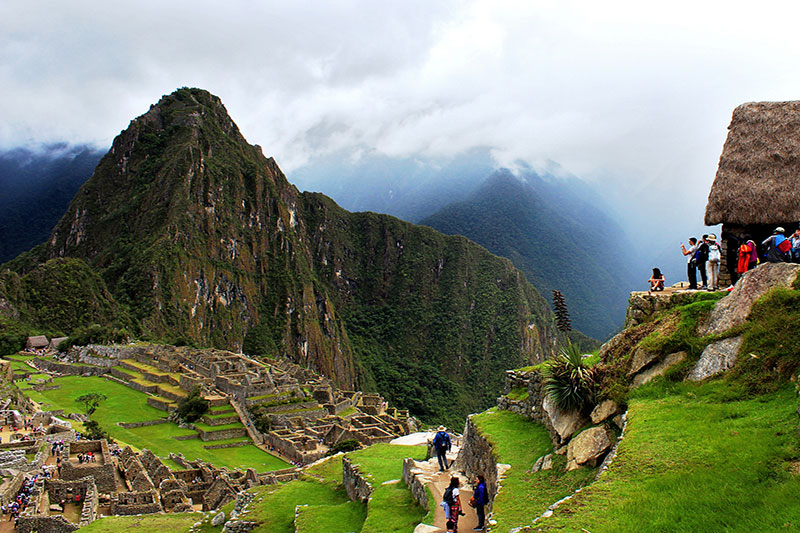
So, why was Machu Picchu so important to the Incas? It wasn’t just some random city up in the mountains. For the Incas, this place had weight — political weight, spiritual weight, symbolic weight. Everything about it was intentional: where it was built, how the stones were placed, how it connects with the mountains and the sun.
To really get it, you have to stop seeing it as just ruins and start seeing it as a statement. A statement of power, belief, and deep respect for the Andean world.
Understanding the deeper significance of Machu Picchu
Why was Machu Picchu so important to the Incas? The answer extends far beyond its dramatic setting or architectural brilliance. For the Inca civilization, Machu Picchu represented a convergence of political authority, sacred geography, astronomical knowledge, and environmental mastery. It was not merely a settlement hidden in the Andes, but a carefully orchestrated statement of imperial vision.
Its importance lay in how it embodied power — not only through control of territory, but through harmony with mountains, water, and sky. To understand Machu Picchu is to understand how the Incas expressed identity, legitimacy, and cosmology through landscape and stone.
The historical context of the Inca Empire
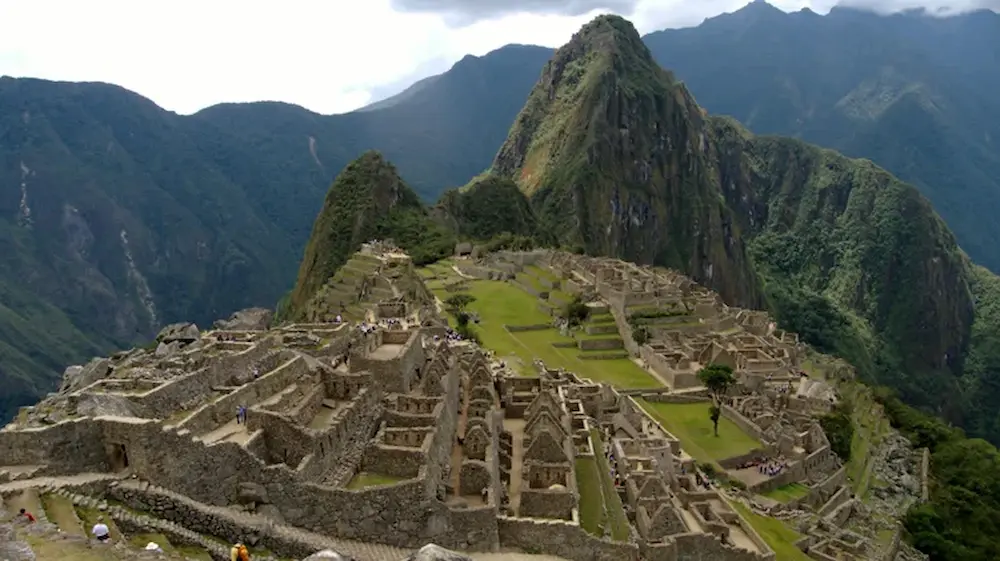
Understanding why Machu Picchu was so important to the Incas requires examining the political and ideological transformation of the empire during the 15th century. The Inca state was not always a dominant force in the Andes. Its rise was rapid, strategic, and deeply intertwined with religious symbolism. Machu Picchu emerged at the height of this transformation, when imperial identity was being carefully shaped and projected across newly incorporated territories.
The expansion under Pachacútec
Machu Picchu was constructed during the reign of Pachacútec, the ruler credited with reshaping the Inca state into a far-reaching imperial power. Before his leadership, the Incas were one regional group among many in the Andes. Through military strategy, political alliances, and administrative reform, Pachacútec expanded Inca control across vast areas of western South America.
This expansion was not solely territorial — it was ideological. Pachacútec reorganized governance, strengthened centralized authority, and elevated the emperor’s status as a semi-divine figure linked directly to the sun god Inti. Architecture played a central role in communicating this transformation. Monumental construction projects demonstrated the empire’s capacity to mobilize labor, control resources, and impose order across diverse landscapes.
Machu Picchu emerged during this era of consolidation as a refined architectural statement. Its scale, precision, and location reflect not only technical achievement but the confidence of an empire at its zenith.
Imperial consolidation and sacred geography
The Incas did not perceive land as neutral terrain. Territory was sacred, animated by mountains, rivers, and celestial forces that shaped human destiny. Political expansion therefore required spiritual integration. Newly incorporated regions were woven into a broader cosmological framework that reinforced imperial legitimacy.
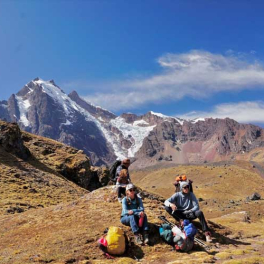
Mountains — known as apus — were especially significant. They were regarded as powerful guardians that influenced climate, fertility, and protection. By establishing Machu Picchu within a dramatic mountain setting above the Urubamba River, the Incas aligned imperial presence with these sacred entities. The surrounding peaks were not background scenery; they were active participants in the symbolic landscape.
This integration of empire and environment reinforced the idea that Inca rule was divinely sanctioned. Sacred geography became a political instrument.
The role of architecture in expressing power
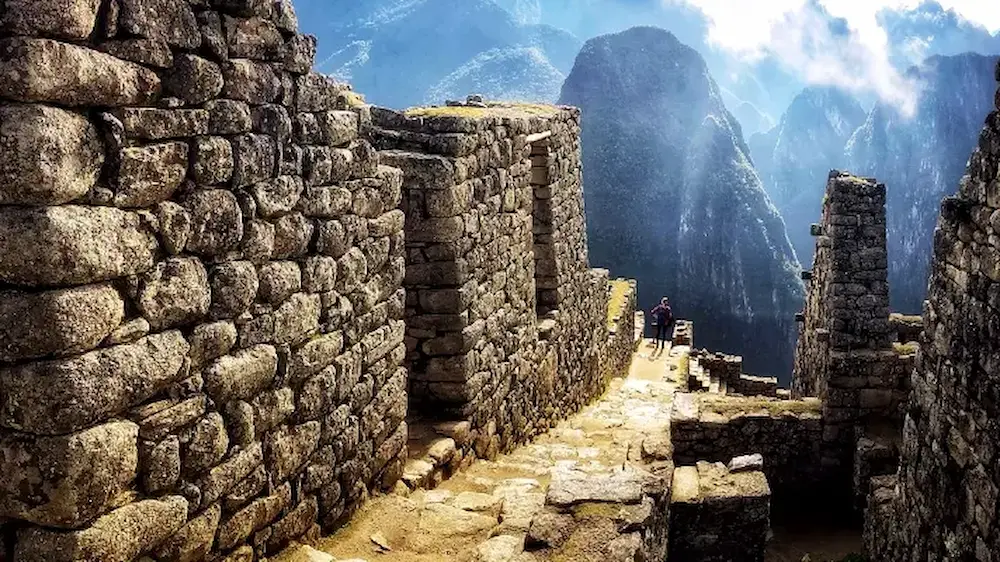
In the Inca worldview, architecture communicated authority without written language. Finely cut stone, symmetrical planning, and precise astronomical alignments conveyed order and cosmic harmony. Elevated platforms and dominant sightlines reinforced hierarchy and control.
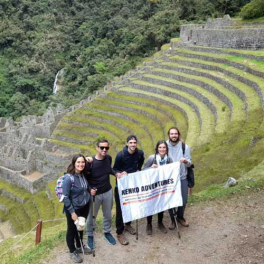
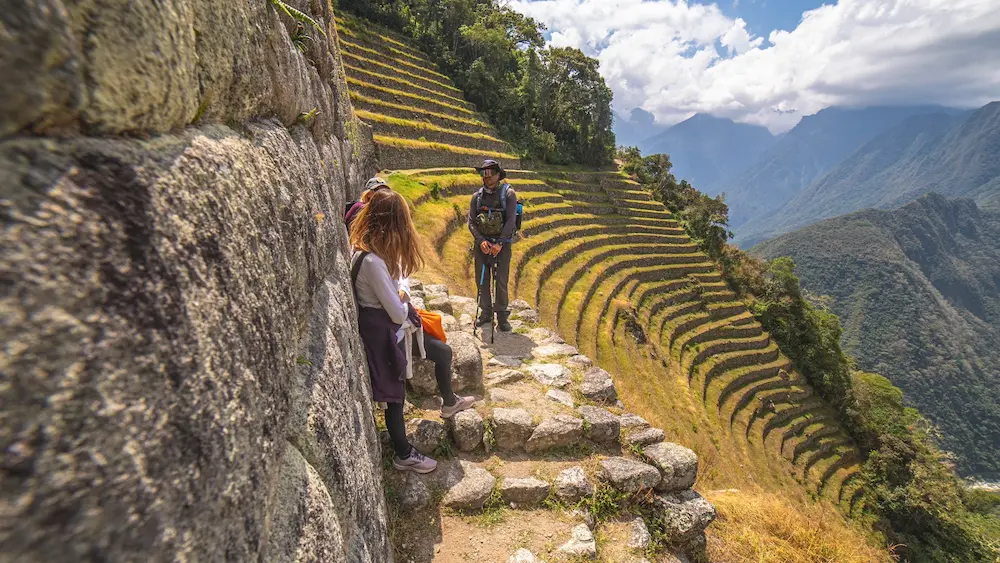
Machu Picchu’s precision masonry reflects immense labor coordination and technical expertise. Its temples and ceremonial plazas demonstrate alignment with solar events, reinforcing the emperor’s association with divine forces. Terraces carved into steep slopes show mastery over challenging terrain.
Through these elements, architecture became a visual declaration of imperial legitimacy. Machu Picchu was not simply constructed — it was composed as an embodiment of power, cosmology, and environmental intelligence.
You might also want to check out: 10 Beautiful places in Peru | Where travel feels real
Machu Picchu as a royal estate
Understanding Machu Picchu as a royal estate helps clarify its deeper political and ceremonial importance within the Inca world. Rather than functioning as a conventional urban center, the site reflects controlled access, architectural refinement, and strategic placement aligned with imperial power. Interpreting it through this lens reveals how the Incas used landscape, exclusivity, and design to reinforce authority and sacred legitimacy at Machu Picchu.
A retreat for the Inca elite
Archaeological evidence suggests Machu Picchu functioned primarily as a royal estate rather than a densely populated city. It likely served as a seasonal residence for the emperor and his court, hosting nobles, priests, and selected attendants. Its limited residential capacity and refined architecture reinforce the idea of exclusivity.
Royal estates were spaces for governance, ceremony, and strategic reflection. In this context, Machu Picchu extended imperial authority beyond Cusco, reinforcing prestige within a sacred Andean landscape.
Political symbolism in a remote sanctuary
Building such a sophisticated complex on a remote mountaintop was a clear political statement. It demonstrated the empire’s ability to mobilize labor, master challenging terrain, and impose architectural order in extreme conditions.
Its isolation increased its symbolic power. Rather than relying on fortification alone, Machu Picchu projected authority through harmony, precision, and environmental integration.
Authority expressed through landscape and design
The site’s spatial organization reflects social hierarchy. Sacred temples occupy elevated sectors, while residential and agricultural areas descend along engineered terraces.
This vertical arrangement was both practical and symbolic. Through careful planning and landscape integration, Machu Picchu became a physical expression of imperial structure, control, and sacred legitimacy.
Religious and cosmological importance
The importance of Machu Picchu cannot be fully understood without examining its spiritual dimension. For the Incas, religion, astronomy, and governance formed a single integrated system. The site functioned as a ceremonial landscape where political authority was legitimized through cosmological alignment and ritual practice.
Connection to sacred mountains
In Andean belief systems, mountains — known as apus — were living sacred entities capable of protecting communities and influencing fertility, climate, and prosperity. Machu Picchu is strategically positioned in visual and energetic relationship with surrounding peaks such as Huayna Picchu and Salkantay.
This deliberate placement embedded the complex within a broader sacred geography, reinforcing its spiritual authority and transforming the landscape itself into an active ceremonial participant.
Astronomical alignments and solar worship
Solar worship was central to Inca religion. The sun deity Inti symbolized divine ancestry and imperial legitimacy. Architectural elements at Machu Picchu align with solstices and seasonal transitions, integrating celestial cycles into stone.
Structures such as the Temple of the Sun demonstrate advanced astronomical precision, marking significant solar events. These alignments reinforced the emperor’s association with cosmic order and affirmed the harmony between heaven and earth.
Ritual spaces and ceremonial platforms
Temples, carved monoliths, and open plazas created formal environments for ritual performance. The Intihuatana, often interpreted as an astronomical and ceremonial device, exemplifies the fusion of science and spirituality within a single sculptural form.
Through these ritual spaces, Machu Picchu became more than a settlement — it operated as a sacred stage where political power and spiritual belief were continuously reaffirmed.
Strategic and territorial significance
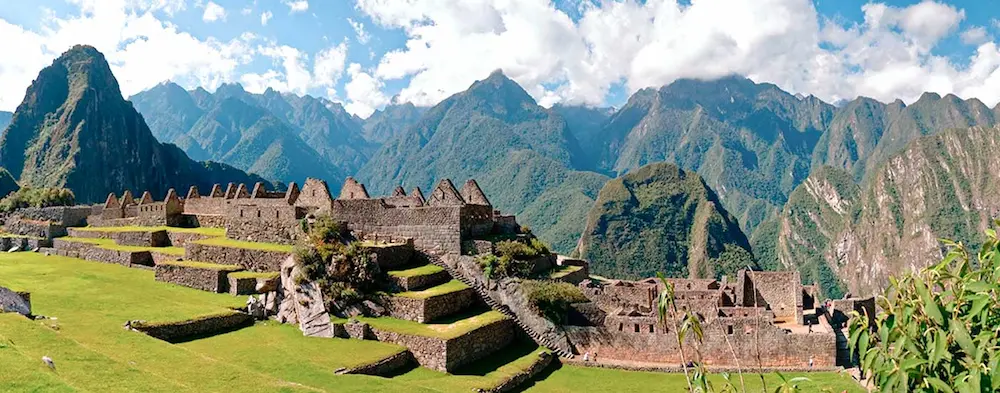
To further understand why was Machu Picchu so important to the Incas?, it is necessary to examine its territorial dimension. Beyond its religious and royal functions, Machu Picchu held strategic value within the spatial organization of the empire. Its placement reflects deliberate planning that combined geography, mobility, and imperial oversight.
Control over regional access
Although it was not conceived as a conventional military fortress, Machu Picchu occupied a key corridor linking the Andean highlands with the Amazonian lowlands. This transitional zone allowed interaction between ecological regions, facilitating exchange of goods, resources, and knowledge.
Its elevated vantage point offered clear visibility over surrounding valleys and routes, strengthening territorial awareness without relying on heavy fortifications.
Natural defenses and geographic advantage
The site’s dramatic setting provided built-in protection. Sheer cliffs, narrow access paths, and surrounding ridgelines created formidable natural barriers. The encircling Urubamba River further enhanced isolation, forming a protective boundary around the mountain ridge.
This geographic advantage reduced the need for defensive walls, demonstrating how Inca planners used landscape as an active component of security strategy.
Integration within the sacred valley network
Machu Picchu did not function in isolation. It formed part of a wider network of administrative and ceremonial centers distributed throughout the Sacred Valley. Sites such as Ollantaytambo and Pisac reinforced regional cohesion, agricultural productivity, and imperial presence.
Through this interconnected system, Machu Picchu contributed to a broader strategy of territorial integration that combined spirituality, governance, and geographic control.
Agricultural innovation and sustainability
The importance of Machu Picchu was not limited to religion or politics. Its long-term viability depended on advanced agricultural planning and environmental adaptation. The Incas transformed a steep mountain ridge into a productive and sustainable settlement through engineering precision.
Terraces as food production systems
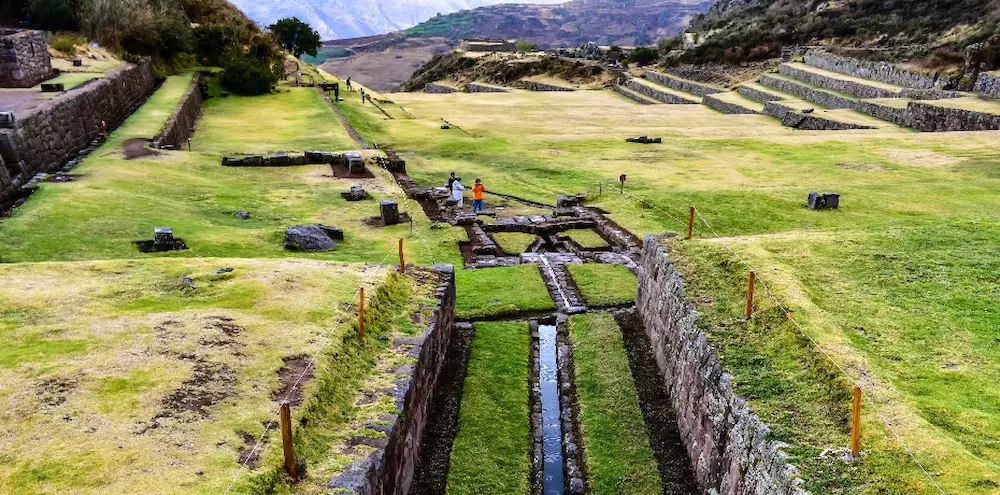
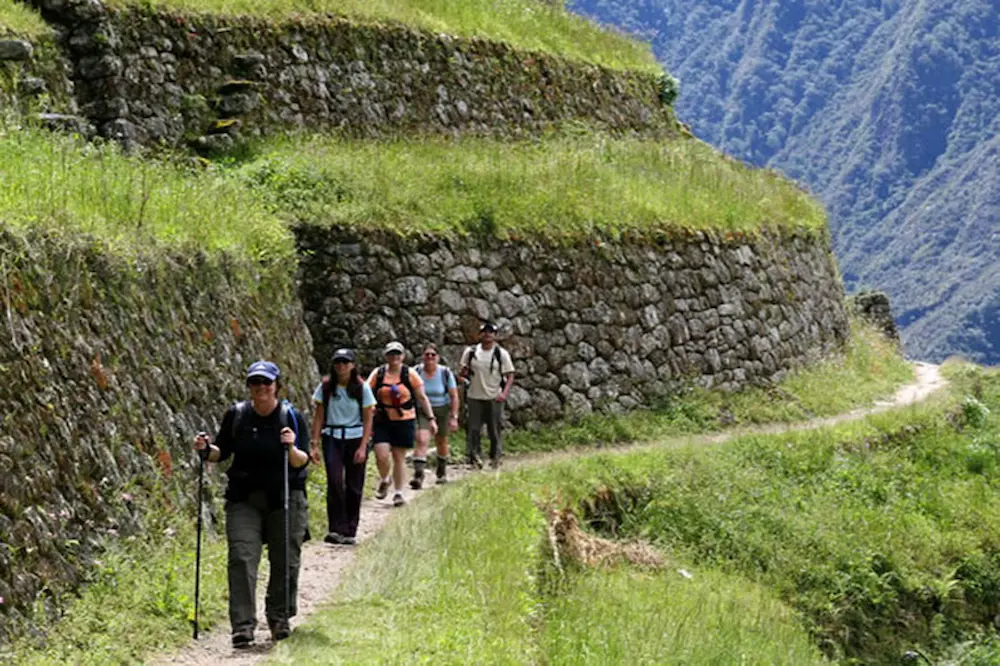
The extensive agricultural terraces carved into the mountainside functioned as highly efficient cultivation platforms. By creating flat, layered surfaces, the Incas maximized arable land in a high-altitude environment where flat terrain was scarce.
These terraces also stabilized the slopes, preventing landslides and controlling water runoff during heavy rains. Their design reflects a dual purpose: agricultural productivity and structural reinforcement.
Hydraulic engineering and water management
Water management was central to the site’s sustainability. Natural springs were carefully channeled through stone conduits, feeding a sequence of fountains and ensuring consistent water distribution across residential and ceremonial areas.
Beneath the terraces and plazas, sophisticated drainage systems filtered excess rainwater, reducing erosion and protecting foundations. This hidden infrastructure demonstrates an advanced understanding of hydrology and environmental balance.
Self-sufficiency in a high-altitude environment
The integration of terraces, controlled irrigation, and local resource use allowed Machu Picchu to operate with relative independence. Food production, water supply, and slope stabilization were interconnected systems rather than isolated solutions.
This capacity for self-sufficiency strengthened its strategic and ceremonial functions, ensuring that the site could endure within a demanding Andean ecosystem.
You might also want to check out: Exploring inca textiles: inside the world of inca fashion and culture
Symbolic importance within Inca worldview
To truly answer the question why was Machu Picchu so important to the Incas?, it is essential to understand the Inca cosmological framework. Machu Picchu was not simply an administrative or ceremonial site; it embodied a worldview in which nature, divinity, and imperial authority were inseparably connected.
The three realms of Inca cosmology
Inca belief was structured around three interconnected realms: Hanan Pacha (the upper world), Kay Pacha (the earthly realm), and Ukhu Pacha (the inner or underworld). This tripartite model shaped spatial organization and symbolic design.
Elevated temples, subterranean chambers, and open plazas can be interpreted as architectural representations of these layered realities. Through verticality and orientation, the built environment mirrored cosmic order.
Architecture as spiritual language
In the Inca worldview, architecture functioned as a form of communication. Finely carved stone, trapezoidal openings, and precise astronomical alignments were not merely technical achievements — they conveyed meaning.
Elevation symbolized closeness to the divine. Alignment with celestial cycles reinforced harmony between human activity and cosmic rhythm. In this way, construction became a spiritual language expressed in granite.
The union of earth, sky, and empire
Machu Picchu integrates surrounding peaks, solar movements, and engineered terraces into a single coherent design. Mountains were considered sacred beings, celestial events guided ritual life, and imperial authority was understood as divinely sanctioned.
By uniting terrestrial geography with celestial observation, the site reinforced the emperor’s role as mediator between realms — a figure who connected earth, sky, and state within one sacred landscape.
Why Machu Picchu was not an ordinary city
Although often described as a “lost city,” Machu Picchu does not fit the profile of a conventional urban center within the Inca Empire. Its layout, infrastructure, and archaeological evidence suggest a more specialized and controlled function.
Limited population and selective occupation
The scale of residential areas indicates a relatively small and carefully selected population. Housing clusters are limited in number, and many structures display high architectural refinement, pointing to elite occupancy rather than dense civic settlement.
This controlled habitation supports the interpretation of Machu Picchu as a royal and ceremonial enclave rather than a bustling metropolis.
The absence of large commercial infrastructure
Unlike major imperial centers such as Cusco, Machu Picchu lacks extensive evidence of marketplaces, large storage complexes for redistribution, or broad administrative compounds typical of capital cities.
There is minimal indication of large-scale economic exchange occurring on site, reinforcing the idea that its primary role was not commercial or bureaucratic.
Evidence supporting ceremonial function
The prominence of temples, carved ritual stones, astronomical alignments, and elevated ceremonial platforms highlights its spiritual dimension. Sacred architecture occupies strategic positions within the complex, emphasizing symbolism over civic density.
Taken together, these elements strongly support the interpretation of Machu Picchu as a ceremonial sanctuary and royal estate — a place where power, spirituality, and landscape converged rather than a typical urban hub.
You might also want to check out: Inca Food: Traditional Dishes and Ingredients
How its importance evolved after the Spanish conquest
Understanding why was Machu Picchu so important to the Incas? also requires examining how its significance transformed after the fall of the empire. The importance of Machu Picchu did not disappear with the Spanish conquest. Instead, it shifted over time — from an active royal and ceremonial estate to a concealed sanctuary, and eventually to a globally recognized cultural landmark.
Why it remained undiscovered
Unlike major imperial centers such as Cusco, Machu Picchu was never clearly documented by Spanish chroniclers. Its remote mountaintop position, concealed by dense vegetation and difficult access routes, likely prevented direct colonial intervention.
Because it was not a primary administrative capital, it may have held less strategic value for Spanish authorities, contributing to its absence from early colonial records.
Preservation through isolation
Over time, the surrounding cloud forest gradually enveloped the structures. Thick vegetation covered terraces, plazas, and temples, shielding the stonework from extensive destruction or repurposing.
This natural concealment acted as an unintended preservation system. While other Inca sites suffered dismantling or urban transformation, Machu Picchu remained structurally intact due to its geographic isolation.
Modern recognition
In 1911, American explorer Hiram Bingham III brought international attention to the site. Subsequent archaeological research revealed its architectural sophistication, astronomical alignments, and ceremonial importance.
Today, Machu Picchu stands as one of the most studied and admired achievements of the Inca civilization — a symbol not only of imperial ingenuity, but also of cultural resilience across centuries.
Frequently asked questions about why Machu Picchu was so important to the Incas
Understanding the importance of Machu Picchu requires looking beyond the idea of a “lost city.” Below are concise answers to some of the most common questions about its political, religious, and strategic significance within the Inca world.
Was Machu Picchu the capital of the Inca Empire?
No. The capital of the empire was Cusco. Machu Picchu functioned primarily as a royal estate and ceremonial center rather than an administrative capital. Its scale and infrastructure do not reflect the characteristics of a densely populated governing hub.
Why was it built in such a remote location?
Its mountaintop position reinforced sacred geography and natural protection. The location aligned the site with powerful surrounding peaks and the Urubamba River, embedding imperial presence within a spiritually charged landscape. The remoteness also enhanced exclusivity and symbolic distinction.
Did it have military importance?
While naturally defensible due to steep cliffs and limited access routes, its primary importance appears ceremonial and political rather than strictly military. There is limited evidence of large defensive infrastructure typical of fortress cities.
Was it primarily religious or political?
It embodied both dimensions. In Inca society, political authority and religious legitimacy were inseparable. Architecture, astronomical alignment, and spatial hierarchy all reinforced the emperor’s divine association while simultaneously projecting imperial control.
A synthesis of power, spirituality, and landscape
Ultimately, Machu Picchu was anything but typical. It was simultaneously powerful, strategic, sacred, and exclusive. The Incas built it because it represented something greater, not just because they could.
It still hits differently today for precisely that reason. In addition to its striking architecture, it serves as a reminder that the Inca civilization knew how to combine authority, spirituality, and nature in a way that is still superior to this day.